
Hierarchical Composite Outcomes - Matched or Unmatched Analysis?
Part 2: The Mechanics of Comparison — Matched vs. Unmatched
HEALTHCARERESEARCHEDUCATION
Martin Krsak
1/29/20261 min read
The power of win-based methods lies in their use of pairwise comparisons.
But how do we form these pairs? There are two main approaches, each with its own trade-offs.
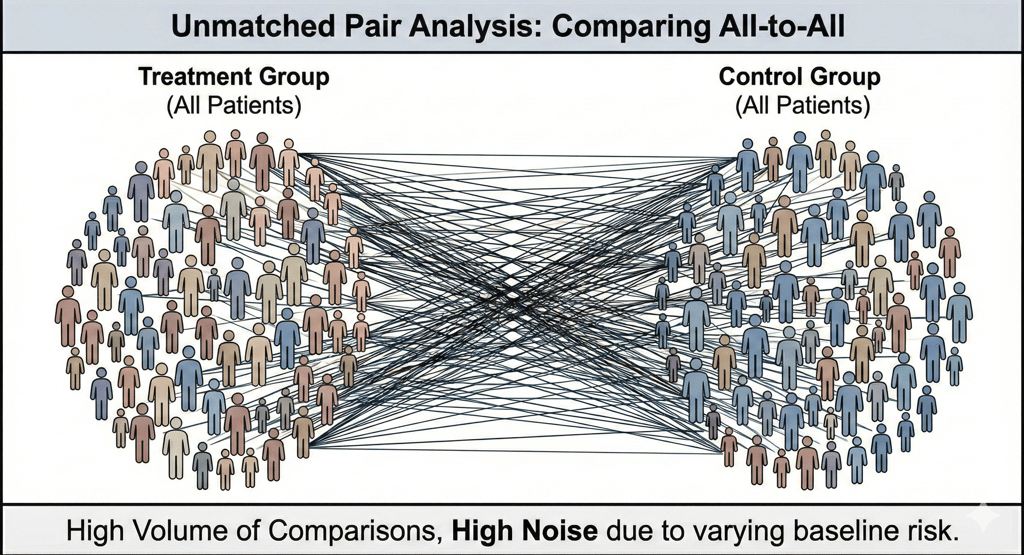
1. Unmatched Analysis: The "All-vs-All" Approach Every patient in the treatment group is compared to every patient in the control group.
Pro: It uses all available data, maximizing the number of comparisons.
Con: It can be "noisy." You might be comparing a high-risk patient to a low-risk patient, introducing variability that's not related to the treatment itself.
Visual: An unmatched pair analysis compares every patient in the treatment group to every patient in the control group, resulting in a high volume of comparisons but also high noise due to differing baseline risks.
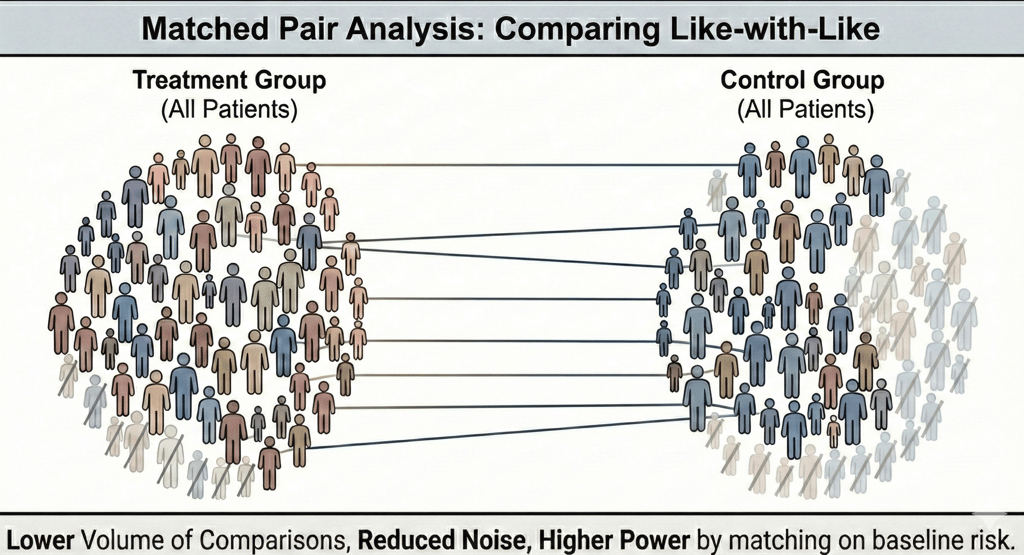
2. Matched Analysis: The "Like-with-Like" Approach Patients are first paired based on similar baseline characteristics (e.g., using a risk score). The analysis is then performed only within these matched pairs.
Pro: It reduces noise by controlling for baseline risk, which can increase statistical power.
Con: Patients without a suitable match are excluded, which can reduce the generalizability of the findings.
Understanding these nuances is crucial when interpreting clinical trial results. Win-based methods, whether matched or unmatched, offer a powerful tool for assessing the true impact of a treatment, especially when dealing with complex, multi-faceted conditions like heart failure.
Visual: A matched pair analysis pairs patients with similar baseline risks, resulting in fewer comparisons but reduced noise and potentially higher statistical power.
Consulting
Expertise in clinical & research management services:
+1-303-564-5110
© 2025. All rights reserved.